Wall Street has stopped waiting for the crypto revolution to fail and has started underwriting its infrastructure instead. This article reports how a surge in institutional capital and a total reversal in Washington's regulatory stance are transforming a monetary project into a permanent pillar of the financial world.
Governments typically regulate in response to crises
American financial history is defined by reactive cycles. From the energy shocks of the 1970s to Enron's prosecution to the financial meltdown 2008, Washington typically waits for a crisis to settle before installing new regulatory guardrails.
Digital assets are no exception to this pattern. A series of high profile cases triggered a period of aggressive oversight that prioritized enforcement over integration.
Initially, federal agencies regulated digital assets without clear statutory guidance
Before 2021, the oversight of digital assets was the domain of federal financial regulators like the Securities and Exchange Commission (SEC) and the Commodity Futures Trading Commission (CFTC) as other agencies largely viewed the sector as too niche to pose a systemic risk. Eventually, they found that their enforcement capabilities were hampered by the obsolescence of their regulatory frameworks.
The Howey test1, an investment contract classification heuristic, and the Bank Secrecy Act (BSA)2 provided overarching guidance on how federal agencies like the CFTC and SEC regulate banks and financial institutions. Because of the decentralized nature of the blockchain ecosystem, both legal frameworks lack governing authority as lawyers can't correctly classify crypto tokens under the Howey test or assign a central figure as the responsible party for financial transactions in case of misconduct.
Following legal headwinds in 2021 (Binance case3, FTX4, LUNA Terra5), the President signed Executive Order (EO) 140676 to outline goals for consumer protection, responsible innovation, and competition in the blockchain ecosystem. The SEC followed with SAB 1217 in 2022, which discouraged institutional involvement in the crypto economy.
More recently, the drive to regulate digital assets has come from institutions
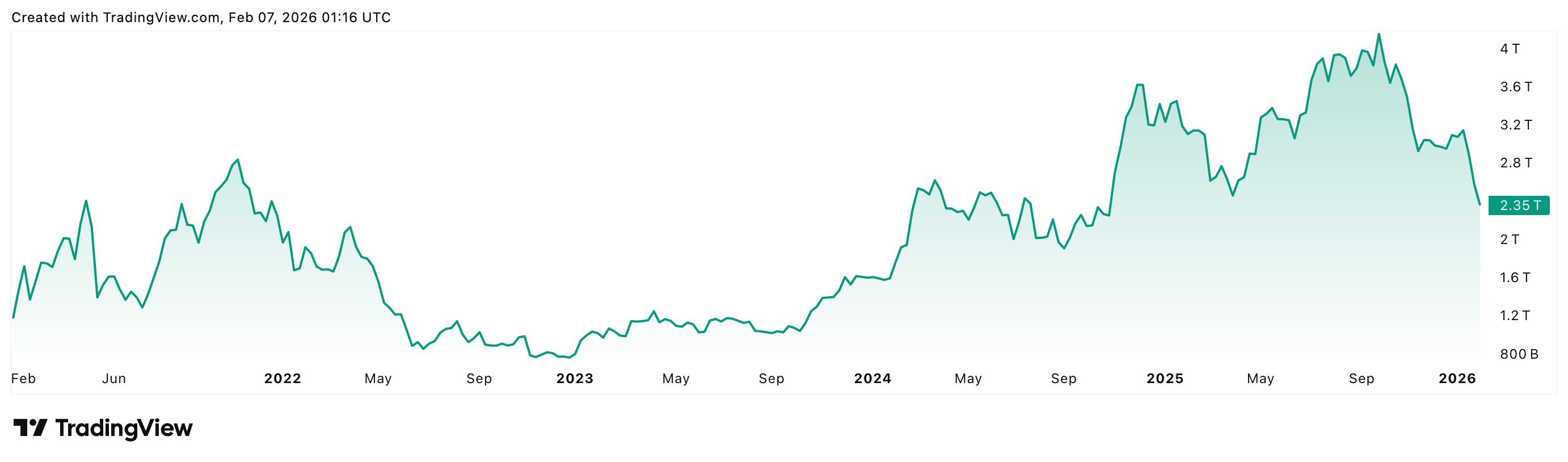
By 2023, traditional banks and crypto retail providers started leading a charge for regulatory oversight and industry reform. Consider Coinbase's regulatory expenditure that doubled in 2022 as shown in Figure 18. Additionally, Uniswap Labs, a leading decentralized exchange, began conversing with the CFTC and the Department of the Treasury, signaling a shift toward bureaucratic engagement9. As the actors closest to the crypto economy sought resolutions to make the ecosystem easier to operate in, the total market cap of the sector increased steadily as displayed in Figure 210.

The industry's push for reform culminated in two key resolutions that finally allowed institutional participation in 2025. The Oval Office signed EO 1417811, which supported the promotion of dollar-backed stablecoins and the endorsement of public blockchain networks. Shortly after EO 14178 was signed, the SEC formally rescinded SAB 12112, effectively ending the "bitcoin-as-a-liability" accounting practice and paving the way for institutional adoption of digital assets.
Following these two actions, larger institutions like Blackrock13 and Fidelity14 started pushing for the passage of the GENIUS Act15 and the Clarity Act16. Increased attention to stablecoins after the 2025 EO prompted further congressional deliberation, resulting in the passage of the GENIUS Act and delineating responsibility for stablecoin enforcement. The clarity in regulatory authority allowed federal financial agencies to publish guidance for holding stablecoins17, allowing traditional banks and credit unions to adopt the asset. The Clarity Act would provide clearer distinction between SEC and CFTC jurisdiction and amend components of older financial bills to allow institutions to hold digital commodities, showcasing that institutions have a stake in the secular adoption of digital assets and the broader crypto economy.
Institutions' drive for regulation is rooted in a need for diversification
The push for a clear regulatory playbook is being driven by a fundamental reassessment of economic risk. J.P. Morgan and other institutional leaders have signaled that a weakening dollar18 and coercion by way of payment rails19 make secular diversification a strategic necessity rather than a speculative luxury.
This shift is the culmination of years of quiet preparation. Major banks have deployed dedicated research teams to the sector since 2018, with most launching formal products by 2021. Because these institutions now hold a significant stake in the growth of the crypto ecosystem, they are aggressively lobbying for the "guardrails" that will allow them to scale their exposure. In an era where global integration no longer guarantees stability, Wall Street is betting that decentralized channels offer a resilient hedge against the breakdown of centralized trust.
At Gadget Capital, our success is directly linked to the maturation of the crypto economy. The institutional and regulatory momentum described thus far validates our investment thesis that digital assets represent a secular growth opportunity rather than a fleeting trend.
References
- Cornell Law School, “Howey Test,” Wex Legal Information Institute. Link ↩
- Office of the Comptroller of the Currency, “Bank Secrecy Act (BSA).” Link ↩
- U.S. Department of the Treasury, Press Release JY1925. Link ↩
- “FTX,” Finance Research Letters, 2023, doi:10.1016/j.frl.2023.103643. Link ↩
- Harvard Law School Forum on Corporate Governance, “Anatomy of a Run: The Terra Luna Crash,” May 22, 2023. Link ↩
- The American Presidency Project, “Executive Order 14067: Ensuring Responsible Development of Digital Assets.” Link ↩
- U.S. Securities and Exchange Commission, “Staff Accounting Bulletin No. 121.” Link ↩
- OpenSecrets, “Coinbase: Federal Lobbying Summary, 2025 Cycle.” Link ↩
- OpenSecrets, “Uniswap Labs: Federal Lobbying Agencies, 2023 Cycle.” Link ↩
- TradingView, “Total Crypto Market Cap (TOTAL).” Link ↩
- The American Presidency Project, “Executive Order 14178: Strengthening American Leadership in Digital Financial Technology.” Link ↩
- U.S. Securities and Exchange Commission, “Staff Accounting Bulletin No. 122.” Link ↩
- OpenSecrets, “BlackRock Inc.: Federal Lobbying Bills, 2025 Cycle.” Link ↩
- OpenSecrets, “Fidelity Investments: Federal Lobbying Bills, 2025 Cycle.” Link ↩
- U.S. Congress, “S.1582—GENIUS Act,” 119th Congress. Link ↩
- Congressional Research Service, “CRS Product IN12583,” on the Digital Asset Market Clarity Act. Link ↩
- Office of the Comptroller of the Currency, “Interpretive Letter 1186,” 2025. Link ↩
- J.P. Morgan Private Bank, “Dollar Diversification: Why Now?” Link ↩
- Jon Egilsson, “Oil for Crypto: How Weaponizing the U.S. Dollar Has Backfired,” Forbes, March 14, 2025. Link ↩